
Complete Origami
by Eric Kenneway
Origami for the Connisseur
by Kunihiko Kasahara
The Complete Book of Origami
by Robert J. Lang
Origami Zoo
by Robert J. Lang
Parts of this list are based on a web site by John
Smith.
Corrections and information about new records are welcome; please
e-mail to info@recordholders.org.
| recommended origami books |
|||
Complete Origami by Eric Kenneway |
Origami for the Connisseur by Kunihiko Kasahara |
The Complete Book of Origami by Robert J. Lang |
Origami Zoo by Robert J. Lang |
| links for ordering origami
paper: |
|||
| 24
sheets
7"x7",
12 colors |
24 sheets 9"x9", 12 colors | rainbow
patterned paper |
metallic
foil paper |
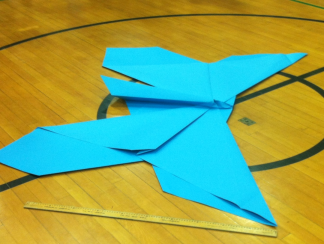
Students at Webster Hill School
folded an origami butterfly measuring 4.36 m x 3.29 m on 11
March 2015. It breaks their own record (see photograph) for a
butterfly with a wingspan of 1.8 m [6 ft] folded from a 2.7
m x 2.7 m [9 ft x 9 ft] sheet of paper in March 2013.
Twenty-five students in Fontaine-Saint-Martin, France, folded a 3
metre tall panda from an 8 by 8 metre square of paper on the
"Salon du Livre pour la jeunesse de Montreuil", December 1993
(source: Guinness Book of Records, French edition 1995)
The largest origami owl was 3.78 m tall, made from paper
measuring 6.5 m x 6.5 m, made by 5 students from Rovaniemi
(Finland) on 9 April 1989
(source: Guinness Book of Records, Finnish edition 1996)
(previous record: A team of six from the MJC Maison-Blanche,
Reims, France folded a 2.6 metre tall owl from a sheet of paper of
16 square metres.)
(source: Guinness Book of Records French edition 1990)
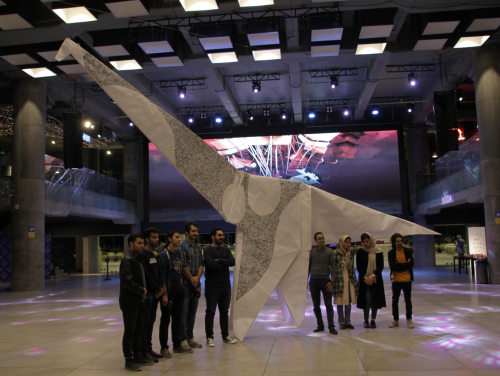
An origami cobra measuring 45.49 m was made at Sentosa Island
(Singapore) on 9-11 March 2001.
An origami caterpillar measuring 649 m (2128 ft) was folded by 60
young people in Heiligenstadt (Germany) in October 2004. They used
25,000 sheets of paper and needed 25 hours. They raised 13,973
Euro for charity in the process.
An origami lei measuring 7,000 m (23,000 ft) was created at
Hiroshima Special Support School (Japan) on 25 August 2013.
A train of 1,550 wagons, 254 m long,
was made at the National Railway Museum in York (GBR) in 2003.
Origami enthusiasts from all over the world sent in paper wagons
to take part in this record attempt.
(source: BBC
news)
A square 1 mm by 1 mm was used to fold a crane using a microscope
and sewing needle by Assistant Professor Watanabe at Nigata
University, Japan.
(source: British Origami, No. 119, page 22)
A. Naito, Japan, folded a flapping bird from paper a mere 2.9 mm
(about 1/10 in) square in response to a 'smallest flapping bird
competition' the bird was only about 2 mm from beak to tail. To
display it, Naito mounted it on a needle inside a transparent
globe. However it was still very difficult to see so Nigel Keen
fitted a contact lens to the outside of the globe through which it
could be viewed.
(source: page 160 of Complete
Origami by Eric Kenneway)
Smallest Fortune
Teller
Éric Roudière (France) used a paper measuring 1.5 mm x 1.5 mm to
fold a 1.19 mm long fortune teller.
(source: Guinness Book of Records, French edition 1990)
Smallest Frog
Christian Elbrandt, Denmark, has folded a 2.7 millimetres long
frog using a pocket lens, scalpel and tweezers. The frog achieved
a jump of 103 millimetres.
(source: Guinness Book of Records, Danish edition 1995)
Smallest Paper Aircraft
Christian Thorp Frederiksen (aged 12 from Denmark) built a paper
aircraft measuring 2.5 mm x 1 mm on 16 March 1995.
(Source: Bornes Rekordbog 1996)
Smallest Flowers
A flower with a diameter of 3.2 millimetres folded by Christophe
Brault, France was shown on the Festival des Records in Beslon,
France, July 1986.
(source: Guinness Book of Records, French edition 1990)
A Kawasaki rose as found in Origami
for
the Connoisseur with a diameter of approximately 3
millimetres was folded by Joseph Wu. This may have since been
superseded by Winson Chan, against whom he is competing in an
ongoing smallest rose competition
Most Butterflies
Evelyne Girard, Quebec, Canada, folded 3000 butterflies in
December 1994 from recycled paper.
(source: Guinness Book of Records, French edition 1996)
Most Paper Ships
Peter
Koppen, a Munich bus driver folds the classic boat (like a
hat) only. He calls them Microships and folds hundreds of them in
different colours and then assembles them into collages. He has
been reported as having folded over two hundred thousand (200,000)
of them.
Largest Fleet of Paper Boats
In September 1980, 13-year-old Markin Kunz of Germany folded
13,131 paper boats in 432 working hours at a swimming pool in
Landau in September 1980. To qualify the boats have to be actually
set on water at the same venue.
(source: Aktuelle Quatsch-Rekorde 1980)
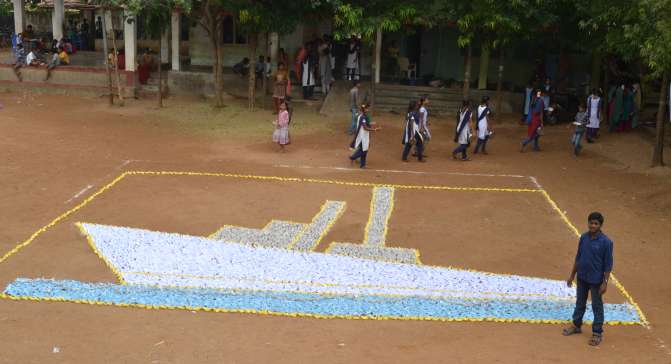
Venkatesh Gattem (India) arranged 5432 paper boats to to a
mosaic showing a big ship [measuring 5.5 m x 7 m] on 16-20
December 2013 (see photo).
1,274,808 paper cranes were folded and sent to the Shin Min
Record Breaking Carnival held from 11 to 13 March at Suntec City,
Singapore. The event was organized by Shin Min Daily News and Song
He Fragrant Rice.
(source: Singapore Book of Records 2007)
To commemorate the fiftieth anniversary of the dropping of the
atomic bomb on Hiroshima, two hundred thousand folded paper cranes
were completed by December 15th 1995. Each crane had someone's
name and peace message written on it. The intention is to preserve
them to hand on to the 21st century. The event was sponsored by
the Hiroshima International Cultural Foundation.
Whipsnade Zoo in Luton (Great Britain) displayed 33,764 paper
elephants which have been sent from supporters around the world at
its Elephantastic weekend on 20/21 September 2014.
Information about paper airplane records can be found at paperaircraft.org. The world record holder Ken Blackburn runs a web site at www.paperplane.org. The World Record Paper Airplane Book by Ken can be ordered here. |
 ORDER at amazon.com from the UK: order at amazon.co.uk |
From September 2000 to April 2001, Nicholas (USA) made a
"Menger's Sponge" level 3 from 66,048 units. DETAILS
Jeannine Mosely USA, completed a level 2 Sierpinksi sponge in December 1995, with 2400 identical modules. It took about 15 hours total to construct, and over a period of about 2 weeks, working on it for 2 to 3 hours at a time, every couple of days.
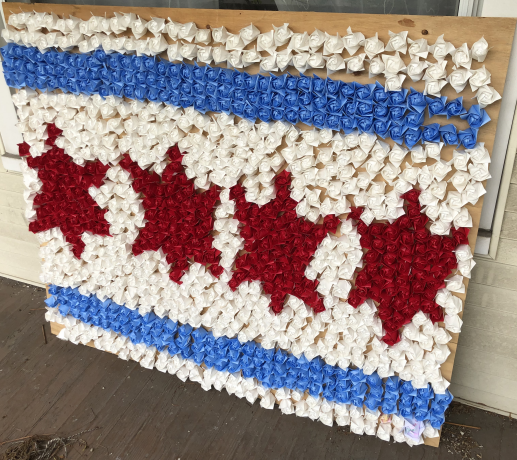
2200 mosaic wall showing the swan logo of the Origami Society Nederland folded at the OSN Convention. Reported by Maarten van Gelder.
900 Sonobe units assembled into a "sphere" by the students of the
Ikeda Institute in Osaka. See Origami for the Connoisseur by
Kunihiko Kasahara. Reported by Valerie Vann.
Lluis Valldeneu i Bigas of Spain has made a cat's face from
10,375 modules.
source: BOS magazine, October 1996.
Note: following advice from Hans Birkland and Robert Lang, I have given up just counting the number of steps or diagrams, which as Robert points out is likely to be dependent on the authors use of a computer which makes it easier to produce diagrams. Instead I have counted the total number of folds needed, so the total I have given is the number of mountain/valley folds, plus the number of reverse folds, plus the number of squashes and so on. But a reverse fold requires the manipulation of 4 creases simultaneously, and a squash is a reverse fold plus a valley fold so requires 5 folds, and a sink of many layers can require the manipulation of 10 or more creases and so on. An approximate estimate I have made suggests that, if half of the folds are valley/mountain (equals one crease) and on average the other half require the manipulation of 5 creases, then the average per fold is 3 creases.)
Lisa Hodson, USA, reported that, under controlled conditions (a flat surface of paper over hard wood floor and no draft), a leap of 74.7 cm was achieved by a variation of the American Jumping Frog by Kennedy published in a FOCA annual (1992?). The frog was folded out of a 15 cm square of white photocopy paper with the grain of the paper from top to bottom at step 1 of folding (the length of folded frog was approximately 5.5 cm). Lisa did not record the date, but it was in April, 1994. Excluding this jump, this particular frog had a mean jump length of about 30 cm. Lisa scientifically demonstrated that for this particular frog model folded out of photocopy paper, the orientation of the paper grain does not significantly affect jump length.
(Well, this is not really Origami,adhesive is allowed, but a cool
contest anyway). The records can be found at www.paperboat.de.