by Aniko Kapornaki and Aron Hegyi (extrem.hu), the organizers of the event
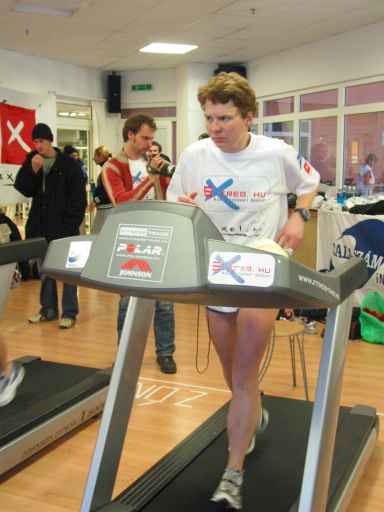 Edit Berces had
never run on a treadmill for an ultramarathon distance. In fact, she
does not use the treadmill for training. When we (at extrem.hu) found an article about
Karl
Graf's 24-hour treadmill record, we asked the elite Hungarian
ultrarunners, whether any one of them is interested in breaking the
record. Edit Berces, the Female Ultrarunner of the Year 2002, agreed
to
give it a try, if we organize the event and the only thing she has
to
do
is running.
Edit Berces had
never run on a treadmill for an ultramarathon distance. In fact, she
does not use the treadmill for training. When we (at extrem.hu) found an article about
Karl
Graf's 24-hour treadmill record, we asked the elite Hungarian
ultrarunners, whether any one of them is interested in breaking the
record. Edit Berces, the Female Ultrarunner of the Year 2002, agreed
to
give it a try, if we organize the event and the only thing she has
to
do
is running.
That is exactly what happened. To make the event more interesting
for
the media, we asked about two dozen Hungarian sportsmen and
celebrities
to take part in the so-called Star Relay. The main task of the relay
was to divert Edit's attention from the monothony of the treadmill
running by just being around, talking to her.
The site of the event was the Fit 4 Fun fitness center in Budapest.
One
of the rooms was emptied, three brand new Johnson T8000 treadmills
were
taken into the room, one for Edit, one as an emergency substitute
and
one for the Star Relay. As the Guinness Treadmill Guidelines orders,
standard treadmill exercise fitness machines were used. That meant
that
we had to restart the machines in every 90 minutes, because even the
expert of the Hungarian distributor of the machines could not decode
that stop mechanism. It was a huge problem for Edit, because she had
to
slow down, suspend her deep concentration ("come out of her
tunnel").
The restart also meant that we had to pay extra careful attention to
the recording of the event. Two cameras were used: one static, which
was rolling behind Edit, recording her running and also showing the
monitor of the treadmill and one of the official watches. The other
camera was recording the tape changes and the 15 restars, each
taking
about 3 seconds. Only one person was allowed to touch the monitor of
the treadmill (besides Edit) and to touch the static camera.
The official start of the run was 6:02 pm on March 8th, 2004. She
was
able to chat for the first 12 hours. The second half was tougher for
her. She said that "I felt like a caged bird, who will be freed only
after 24 hours. After eleven hours I did not even see the end of the
tunnel. I was not prepared to run for another 13 hours. I switched
off
the outside world, and concentrated only on running." Throughout the
24
hours, she used four rest breaks "for hygenic reasons", but she not
even once stepped off the treadmill.
After the 13th hour, the math class began. Edit's two helpers,
Oliver
Grof and Gyula Lestyan did the math for her. She told them that she
felt strong enough to go for Serge Arbona's 100-mile record. After
the
13th hour, (in the 14th) she did 11.1 kms, in the following hour,
she
did 11.5 kms. (Her total average was an astonishing 10.3 km) After
14
hours 15 minutes and 8 seconds, she became the new world record
holder
on 100 miles. It was her sheer determination, which led her to the
new
record. It gave her confidence to go for another two records: she
broke
the women's 24-hour record, the 181.3 km set by Christine Sextl on
March 6-7, 2004 after 16 hours 9 minutes and 51 seconds.
She had another 8 hours to go for the male record. Edit is the world
record holder on track in 24 hours with 250.106 km, but she needed a
much stronger will power and determination to go for the same
distance
on a treadmill, a completely new territory for her. After having run
20
hours and feeling strong, Edit said that "ok, enough of jogging, now
I
will start running".
A main helper for Edit's fantastic run was the weather and Edit's
huge
experience. Edit paid an extra careful attention to David
Deubelbeiss's
and Monica Scholz's February 12-13 attempt. David suffered a heat
stroke after the 20th hour. Edit did not want to fall into the same
trap, so she ordered us to open all the doors in the room. The
"Welcome
to Alaska. The temperature of the room is 9 degrees Celsius. Please,
take on your coat, gloves and hat, unless you are running. Thank
you.
The organizers." was posted on the entrance for a good reason. While
the helpers, the time keepers, the witnesses, the reporters were all
dressed up, Edit was running in a short and a T-shirt. She was
hardly
sweating. It was her decision to run in 9 degrees C, while it was
snowing outside, and we respected her decision.
For the last hour, the most famous Hungarian Ironman, Peter Kropko
stepped on the Relay treadmill, following Rita Pesuth, the six-times
kick-box World Champion. Peter is one of Edit's favorite sportsman,
and
he was one of the few people, to whom she was willing to talk to.
Peter
used all his sportterapeutic skills to enter her closed world. Edit
reached Serge Arbona's World Record after 23 hours, 27 minutes and
21
seconds. By that time the room was filled with cameramen and
reporters,
who were pussing and shoving for the best spots in front of the
treadmills. She decided to "take it easy" for the last half an hour,
not overstreching her limits. She was walking and chatting with
Peter
and the reporters. The camerashy Edit became a media star. The
reporters, most of whom had not even known that ultra running
exists,
understood what she has achieved and were humbled by her three world
records. Answering a question, she told the benumbed reporters that
she
was only using this event as a preparation for her run around the
Lake
Balaton, a darling project of hers.
PROGRESS LOG
(source: extremelife.hu)
after hour 1: 11.3 km
after hour 2: 23.5 km (12.2 km in the last hour)
after hour 3: 35.4 km (11.9 km in the last hour)
after hour 4: 47.4 km (12.0 km in the last hour)
after hour 5: 58.9 km (11.5 km in the last hour)
after hour 6: 70.8 km (11.9 km in the last hour)
after hour 7: 82.2 km (11.4 km in the last hour)
after hour 8: 93.3 km (11.1 km in the last hour)
after hour 9: 104.4 km (11.1 km in the last hour)
after hour 10: 115.2 km (10.8 km in the last hour)
after hour 11: 125.3 km (10.1 km in the last hour)
after hour 12: 136.1 km (10.8 km in the last hour)
after hour 13: 146.8 km (10.7 km in the last hour)
after hour 14: 157.9 km (11.1 km in the last hour)
after hour 15: 169.4 km (11.5 km in the last hour)
after hour 16: 179.5 km (10.1 km in the last hour)
after hour 17: 188.4 km (8.9 km in the last hour)
after hour 18: 199.4 km (11.0 km in the last hour)
after hour 19: 208.2 km (8.8 km in the last hour)
after hour 20: 215.3 km (7.1 km in the last hour)
after hour 21: 224.7 km (9.4 km in the last hour)
after hour 22: 233.0 km (8.3 km in the last hour)
after hour 23: 241.4 km (8.4 km in the last hour)
after hour 24: 247.2 km (5.8 km in the last hour)
Treadmill
World
Record List